

Feeling Forever
Defending affect theory (1)

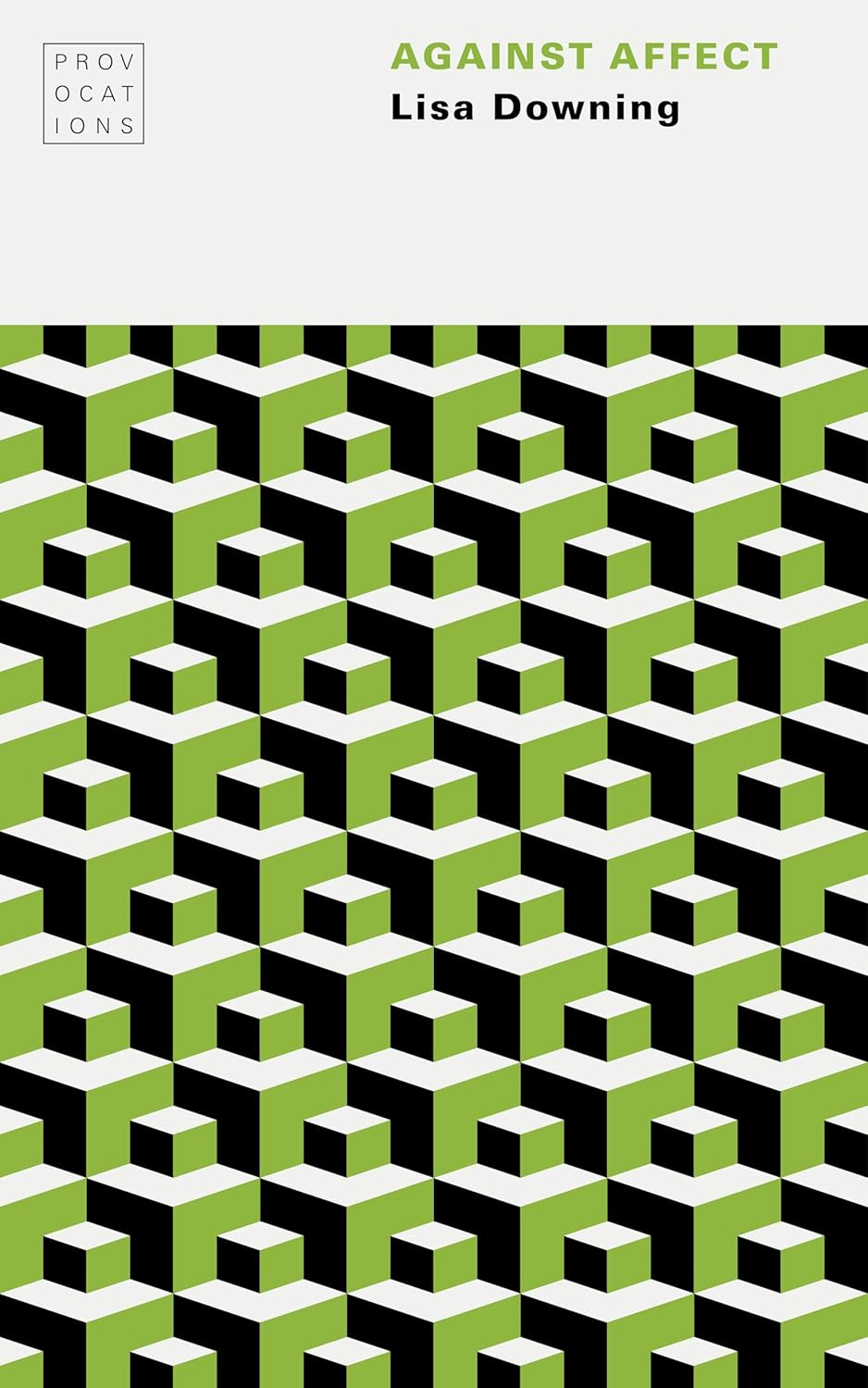
You’ll never see me denying the scholarly import of feelings, and in the spirit of putting my money where my mouth is, here’s one to get us started: I can’t recall ever reading a single page of scholarship from a feminist author that I hated as much as I did the first page of Lisa Downing’s Against Affect. Nearly every sentence, line by line, and in a variety of ways, seemed designed to send me into a fit. I begin this post by trying to understand my own exceedingly emotional reaction by proceeding sequentially and somewhat pedantically. I am attached to affect theory and use it in my work. Is my distaste for this opening salvo simply a defensive reaction?
The Opening Lines
Downing begins:
The language of emotion is historically gendered and racialized to the detriment of women, people of color, and other nonnormative subjects.
So far, so good. Factual and well-established. Goes without saying.
Affect theory has elevated emotion and feeling both the academy and in contemporary culture to the degree that prioritizing them has become not only the hegemonic norm, but also a strategy that is cynically deployed in the service of exercising power.
And we’re already off the fucking rails. I mean, honestly. The passive voice is intentional and obfuscating: none of the people or institutions doing any of the things Downing claims are being done are identified anywhere. But let’s back up.
First of all, “affect theory has elevated emotion and feeling both in the academy and contemporary culture” yes. But hegemonic? According to whom? In what contexts? How can one seriously claim that attention to feeling and emotion are hegemonic in “contemporary culture” (what does that even mean, as if right-wing podcasting and queer book clubs exist in the same cultural soup?) when we are smack in the middle a resurgent alt-right dogma in which emotions are openly vilified and attacked?
How can one seriously claim that feelings are foregrounded when the literal government of the most powerful and violent nation on the planet is staffed by alt-right influencers proving traditional masculine bona-fides by bench pressing and frat partying their way to power, refusing any emotion besides anger along the most simplistic, regressive, sexist lines imaginable? Like cartoon characters of men that Downing’s opening salvo simply denies exist? As if sensitive English professors are the true hegemons instead of those clowns?
This is to say nothing of the fact that there is no such thing as “the academy,” but rather clusters of interrelated and distinct institutions. Are we talking about humanities disciplines here? Surely Downing doesn’t believe that feelings have become dominant in computer science PhDs. Even still, I struggle to imagine that all the analytical philosophy programs dominant at elite institutions find themselves awash in the kinds of literatures Downing is ostensibly referencing here, which they have been dutifully and quite successfully ignoring for decades. Again, the lack of specificity made possible by the passive voice lets Downing off the hook for any kind of accountability even with the the second sentence. I’ll come back to the point about cynicism allowing people to exercise power. Seems to me that they’re exercising it just fine already.
I understand that these opening pages represent something of a manifesto in miniature; it will be the task of the rest of the book to prove that its provocations are warranted, that there is some kind of pressure out there demanding that academics grapple with feelings and dispense with reason. It may be unfair for me to look for such evidence and careful argumentation in the opening pages, which, like the rest of the book, are designed to be polemical. And yet is there ever an excuse for writing sentences that are demonstrably wrong?
The duty to put emotions and feelings first has led to a climate of authoritarian censoriousness and self-censorship that it is now time to challenge.
Simple criticism to start: the word “duty” smacks of anti-wokeism. It’s like saying the post 2020 injunction to consider the ways that we might unconsciously be reproducing inequitable biases and how we might do better going forward was an ask too onerous to contemplate, in fact just a form of reverse-discrimination. What dean of what school anywhere is pressuring us all to write about the same things in the same ways? Downing writes here as if her annoyance at having to grapple with something that has historically had NO PLACE in academia is an inconvenience that outweighs centuries of patriarchal influence on the humanities, the same way that being asked to consider how centuries of structural racism might still be showing up in our workplaces occasioned a backlash from those who simply didn’t want to think about it. “It is not the time to recycle right-wing talking points even if we are doing that to be funny or to show moral growth or to make our books sell faster.”
Furthermore, affect theory has never claimed that feelings and emotions need come “first” or in everyone’s scholarship; it has simply fought for feelings to have a place at the table as an equally valid mode of knowledge-making, which was (again) a necessary intervention given centuries of sexist dismissal that Downing nominally acknowledges in the first sentence of this book.1 It is textbook bad faith to suggest that fighting to be recognized in any capacity means that anyone (again: WHO?) has made a demand or an imperative to treat affect-oriented scholarship with any kind of a priority.
In fact, from my position in music studies, this is especially laughable. I just received a peer-review last month that displayed open skepticism of if not hostility toward affect theory, and suggested that if I were going to insist on using it, that I might want to engage with any of the “voluminous critiques of affect theory” in order to demonstrate that I understand the risks associated with that methodology. I point this out here for two reasons: 1) skepticism towards affect theory is alive and well. 2) There have indeed been, from the very beginning, “voluminous critiques,” which you wouldn’t know if Downing’s was the first you picked up.
Her premise here makes it out like “the time has finally come for a full-throated critique of this ubiquitous mode of theorizing!!” when in fact the critiques have already been there, and the theorizing is far from ubiquitous. Affect theory has always been marginal, especially insofar as it has been embraced by queers of color in the academy, a point to which I’ll return.
To continue: what Downing does here is conflate a non-existent academic pressure to embrace a certain way of thinking—a pressure that again, no one has had to abide by or give in to—with authoritarianism. This while literal authoritarians disappear people to literal concentration camps. But the problem, we are told, is with all of our soft and squishy scholarship instead. There are genocides happening in broad daylight. It’s raining oil in Iran. And Downing uses the word authoritarian for our scholarship. Page one.
The Bullet Points
Asking why affect theory chose to revalorize feeling rather than redistribute reason, I claim that:
If the ideal of reason were not the better, more productive, more pleasurable virtue, the eighteenth-century Enlightened patriarch would not have claimed it for himself as the proper condition of maleness.
Well, ok, so this is what happens when you refuse affect theory outright: one of the first and most critical arguments of affect theorists has been that the binary division between reason and emotion is a fiction, a fiction that makes it easier to associate one with men and the other with women. Downing here reifies this falsity by taking it as truism and hopes readers will simply swallow it.
Being able to ‘stand in someone else’s shoes’ (empathy) is not morally superior to deciding rationally to stand ‘alongside’ them (solidarity)
Hey ok! I buy this one. The problem is that affect theorists have not fetishized empathy, as claimed. At the very least, there has been a debate about the values of empathy and some serious skepticism articulated by recent work: here’s one example. First and foremost, attention to feeling grows from the kind of identity politics advanced by the Combahee River Collective, which argued not for a solipsistic “everyone has their own individual experience” version of the concept, but one that theorized broad, collective experiences outward from the way that structures of power appear in people’s lives in an immediate, sensorial fashion. “You point to a structure, they hear feeling.”
We must resist the Tyranny of Vulnerability.
Who hurt you?
We must not permit any set of ideas to be off-limits for legitimate critique; squeamish leftist denials of the existence of a ‘culture war’ simply cede the ground of defining the terms of that war to the right.
Once again, I am at pains to imagine what kinds of leftists Downing is listening to or talking about, but I find the word “squeamish” instructive of her orientation. It tracks with the earlier use of the word “authoritarian,” as if the violence we are witnessing is our own fault rather than the fault of those perpetrating it.
The impulse to blame “ourselves” for emergent fascism—rather than the fascists who have been hiding in plain sight this entire time—bespeaks a fundamental misreading of what we’re up against. At worst, it betrays sympathy for a rabid colonial ideology that in various forms ties together the entire history of the west from the colonial period to the present. The fascists have always been here. They’re the ones conducting the colonial slave trade, fighting the civil war, opposing reconstruction, joining the KKK, joining the police, joining ICE. They didn’t spring into existence when academics (in some corners of the academy) started taking emotions (more) seriously. Oh, by the way: the departments that most thoroughly embraced feeling as a legitimate source of knowledge are the ones being phased out right now. Where’s your hegemony, then?
A commitment to recognizing that feelings are real, powerful, and inevitable must not prevent our urgent critique of the use of emotive language for propagandist ends.
Cool, sick, great, that’s been a central aim of affect theory for a long time.
It is better to redistribute reason than to revalorize affect.
Obviously the conceit behind the book. Impossible to judge without reading further, but again I question why Downing insists on the binary instead of the messiness of experience. Ah, right, that’s why: mess is the purview of affect. Hermeneutic (one might say artificial) categorizations that don’t hold up in the light of lived experience are the purview of those disciplines predicated on “reason” (so, most of the rest of them).
A reinstatement of the values of freedom of expression (however hurtful) and reason as an ideal (if not always a perfectly executable one) are the necessary conditions for liberty, compassion, and respect”
More anti-wokeism. The only people limiting freedom of expression are the authoritarians who fire people for being Black or for speaking up against the genocide of Palestine. It’s not the leftist academics fighting against freedom of expression, especially not the affect theorists, even if they had the power to do any of that fighting. (Again: disciplinary influence is not the same thing as hiring and firing power, or the power to lock people up.) Again: I am enraged and befuddled because this isn’t abstract; fascists are running the global economy (into the ground). Many of them also have academic positions. And you’re coming for us? The ones trying to insist on the validity of feeling emotions?
As the most effective redress to the failed affective turn, we need to imagine and work toward a Feminist Neo-Enilghtenment.
I don’t even know what to say about this except that I’d be more likely to want to consider it if the foregoing hadn’t screamed of so much bad faith and internalized conservatism. But considering that reaction in readers would require thinking through the role that emotions might play in the reception of this book.
Beyond
It’s not smart to judge a book from two pages, but openings can do a lot to indicate an author’s investments and orientation. I plan to read the rest one way or another, and to return here once I’ve done so. In the meantime, part of the reason that my defenses are spiked is because of another book I reviewed and then later came to see differently, another book that I’ve come to believe was written in bad faith, despite making some good points along the way.
Beyond this, the turn against affect and too often the women of color associated with it is spreading, even in books that I otherwise find valuable and provocative. My plan is to turn this defense into a series, with the goal of drawing attention to affect’s nuances as both a method and a body of work, nuances too often ignored when critiques of an entire field become tempting for an author who seeks to “intervene” and perhaps in doing so raise their own clout.
There are some good critiques of affect theory, in part because affect theory isn’t just one position or scholarly orientation. I want to engage with those good faith arguments as well. So far, Against Affect doesn’t seem to be one of them.
Maybe some affect theorists have argued polemically for the priority of feeling, but to even suggest that affect theory has been a complex and contradictory field—full of debates, differing views, and people from a range of disciplines—is a level of nuance Downing does not grant.
Great! Full stop. I don't know the book, but your description identifies sloppy thinking that is not productive for anyone. I'm eager to read more of your thoughts on this book (as you read it) and your defense of affect theory (which as you note, has many channels).