

Drastic Measures
Nothing about February is subtle

Everyone must start with the horrors. To begin anywhere else is to appear daft, sheltered from the pain or actively repressing it. It’s not a month into the term, and already my friends are unsure if they still have their jobs, are unable to renew their passports, are terrified of getting swept up in a raid. Already academic freedom takes another massive hit, as if it could have sustained one. Our university president sends out a non-statement about the fact that yes, the NIH cuts will affect us (but no, implicit in the message, we won’t do anything to protest). That a single South African billionaire can just decide that the Consumer Financial Protection Bureau doesn’t exist is terrifying less because of any immediate financial danger to me personally and more because it signifies that the constitution of the United States—an imperfect document, but one around which our parties used to have relatively consistent perspectives—is not in effect. If that fact is allowed to stand, what new disasters will result?
Some folks have been fighting a feeling of hopelessness by sharing stuff like this, arguments that push back against the ostensible common-sense that “nobody is doing anything” about the administration’s naked authoritarianism. “This is patently untrue. And yet people keep repeating it,” Sherrilyn Ifill says, and she’s right: All kinds of people are doing all kinds of things, and it can help us to feel better when we join them.1 But in the meantime, it’s also important to consider why people keep repeating it. If it’s untrue and demoralizing, where does the “common sense” originate?
I can’t answer for everyone, but for me it originates in the Democratic party, who I see consistently turning away from, sidelining, and otherwise castigating the only members it has who can communicate effectively with a terrified and frustrated population. The party’s choice to elect 74 year-old cancer patient Gerry Connolly over AOC for the critical house oversight committee is just the latest instance of the party stepping on rakes all over the place, funny if not for the contempt underlying its stupidity: They will literally harm themselves before electing anyone with good ideas, no matter how marginally they differ from mainstream politics, no matter how well AOC has played ball since entering congress.
What I’m saying is that it seems like people aren’t doing anything because the people who are supposed to be—the most powerful, the most capable—aren’t. “I reject and resent the implication that congressional Democrats are simply standing by passively,” says Rep. Ritchie Torres. Congratulations on your resentment, sir. But if congress is doing something, we can’t see it. Maybe that has something to do with the fact that said actions are taking place in private, saving some notable exceptions from the wing of the party that gets blamed every time for every bad outcome:
What can Democrats do when they don’t control the government?
I don’t fucking know. What I do know is that South Korea just took drastic measures to prevent a coup, just scaled buildings, suspended normal order, and treated the crisis like it was one. People across the States are sounding the alarm. A glorified shrug from congress is not enough.
Making Efforts
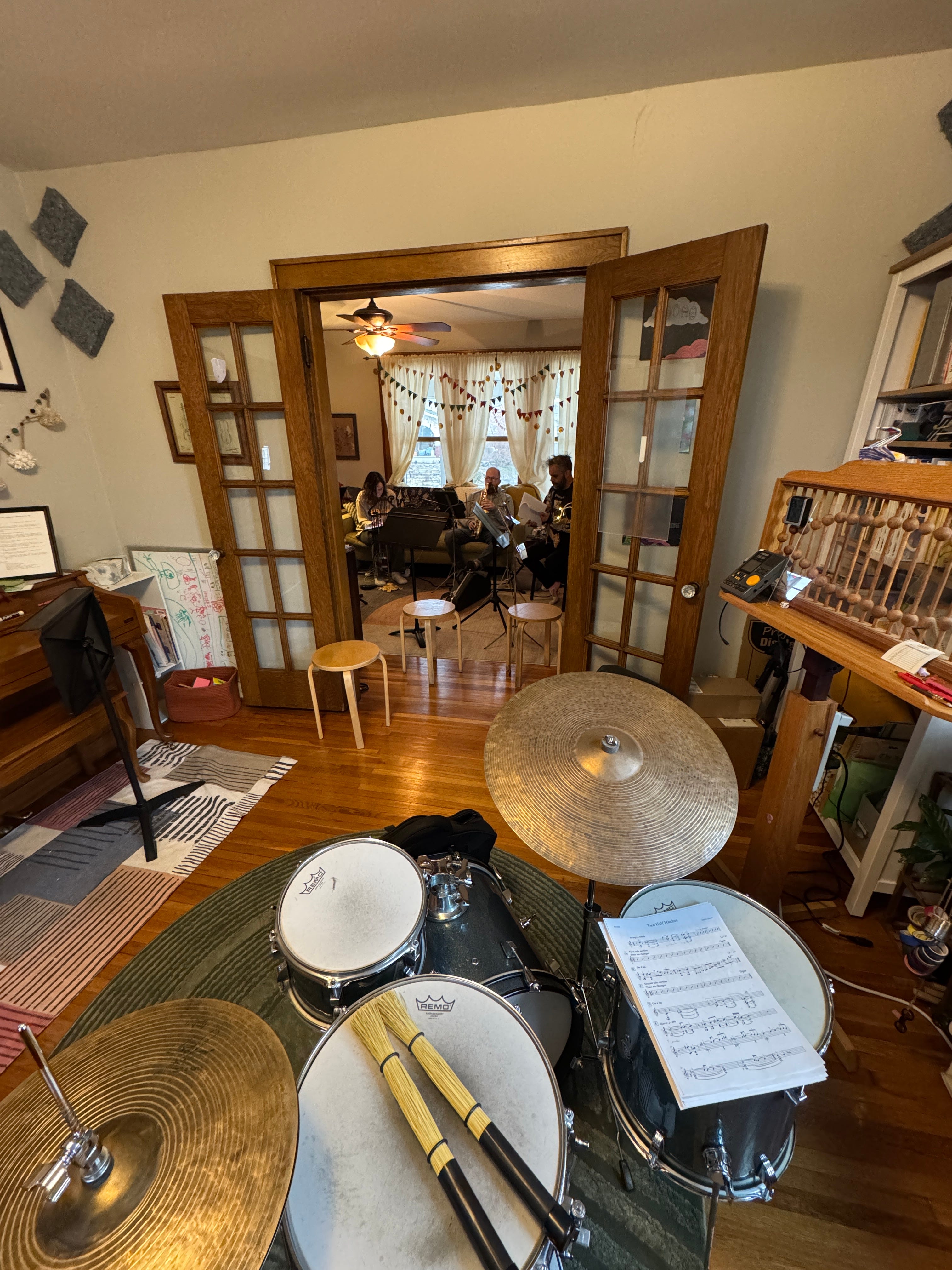
Last week, I drove ten hours—split over two days—to be in Columbus, Ohio, the city that still feels like my home despite moving away in the summer of 2022. Once there, I taught some drum lessons, worked with the rhythm section in a few university ensembles, and rehearsed my friend’s music—some dozen charts of music for nonet, among the most difficult reading I’ve had to do in years. We rehearsed for six hours, and I know most of the band—if not all—was shedding the parts independently. Nevertheless, in the parlance of the day, we still ate shit at the performance.
Which isn’t to say that it went poorly! I think the sound of people trying hard and working through something collectively, with every missed cue and bungled figure, can sound cool in its own way, the affect of effort. We kept the energy high into the night, and beautiful moments happened across every tune. More than anything, it was a privilege to gather, to travel from far away and work on something together. At one point during the week, I took a picture of some of us walking across campus, a picture I could have taken in its exact composition as far back as 2008; but in this version, instead of going to class, we were on our way to teach it.2
In 2009 I wrote a tune called “Everything We’re After.” What it evoked for me at the time and still was this precise sense of our little group of musicians—training at a conservatory basically no one’s heard about in the middle of a state no one takes seriously—splintering, leaving to pursue whatever version of the work they felt demanded their efforts.
We were all working on the same thing, fundamentally, but needed to get to it in our own ways. Aaron left for New Jersey, Robin for Boston, Robert for Los Angeles, Michael for I don’t remember where (Alaska?). Some people stayed and worked on it that way. Some came back for good or just for a pause. I myself returned and was happy. It is rare, anymore, to be able to gather and witness how each pursuit has resulted, the ways that someone’s music or thinking have been honed in the years since departing, taking on all kinds of life stuff along the way. It is a miracle each time. We’ve learned so much about ourselves that we’re starting to forget, need friends to remind us.
But beyond the music, the occasions through which we can justify our convening also return into my life a practice that Sheila Liming points out is under threat of disappearing altogether: hanging out. Rehearsing, performing, sometimes working, but at the end of the day all coming back to the same house to sleep—gathering from out of town requires extraordinary efforts at the same time that these very efforts also suspend daily life such that hanging out becomes possible again. “You'd Be Happier Living Closer to Friends. Why Don't You?” asks Anne Helen Petersen. And we all know why. But some days, I am more ready than others to disregard all those very good reasons. In any case, that we will need each other more during difficult times is apparent to everyone, and difficult times are all I see on the horizon.
Rec
TEN FUCKING YEARS AGO3 Aaron and I played a show and recorded it, very poorly.4 I think the whole thing is wonderful, even if the sound quality isn’t. “Not Quite” is one of my favorite things I’ve written.5 I love all Aaron’s tunes, but can I particularly recommend checking out the transitions from 2:20-3:00 in “Grape”? And cry(ing) hard(??)
Please check out her article, which has great resources. For my part, I’ve been leaving unhinged voicemails with my representatives, who suck and deserve it.
That a sizable contingent of my friends has taken over jazz instruction at my alma matter has as much to do with the latter’s impending bankruptcy as it does the former’s brilliance; but we’ll leave that particular topic for another time.
In August
Headphones r e c o m m e n d e d d d
But “Pen” is pretty good too.
Reading this made me feel sane.