

The Blurb
On academic publishing (1)

Hi friends,
As the summer really kicks into gear, I want to trot out another lil series that I hope will be of interest to folks, this one on the idiosyncrasies of academic publishing. I’m no expert here, but I do have quite recent experience publishing academic books; and given how opaque/weird the process can seem from the outside, I think there’s always room for more conversation about what’s expected, what matters (and to whom), and how the process typically goes.
The first thing I want to say about this—and something I will continuously say about it—is that anyone looking to publish an academic book (especially in the social sciences and humanities) should get on top of Laura Portwood-Stacer’s work, if you’re not already there. I mean it. Laura is brilliant, and has helped both myself and my friends get their books written, pitched, and ready. She offers tons of free or low-cost materials (The Book Proposal Book alone is worth its weight in gold), and she also offers courses for those who would benefit from co-working and real-time feedback. I simply cannot recommend her work highly enough, and nothing I write in this space will substitute for her expertise. If you need help publishing an academic book, start there.
Blurbing
Today, I’m thinking about blurbs, those endorsements from peers that appear on the back of every book, but which seem particularly important somehow for academic writers. A trade author is hopefully going to have lots of material to choose from, hopefully will be reviewed in any number of papers (ahem, websites) and will thus have a larger list of kind words and praise with which to adorn their jackets. In the academic world—if your book gets reviewed at all—it will most likely be reviewed in a peer-reviewed journal, behind a paywall, at minimum a year after your book comes out. That’s not of any particular help in terms of finding endorsements before the fact, endorsements that you hope will encourage interested readers to buy the damn thing.
Blurbs also seem particularly important for academic authors because we are so specialized, which is to say because we work on a tiny corner of a tiny corner of a field of knowledge. If you’re one of the half dozen people working on a given topic, you want to make sure that some of the other five people recognize and find validity in what you’re doing. This can also signal to potential readers, oh wow, this new book on x topic is being praised by the author of an earlier book on x topic—this helps establish a kind of scholarly lineage or trajectory, signaling to the reader that the author is part of a larger conversation beyond their own interests.
In this way, blurbs may not “do much” in terms of moving sales or materially affecting the life of any given book; but they feel deeply, deeply meaningful for the author who receives them, a kind of validation that’s so rare in the world of academia. After untold years of work, a writer you admire has said kind things about your book! This is a tremendous feeling, if nothing else.
WhoM Do You Ask?
Figuring this out can be tricky, even if there are only a handful of you working on a particular topic (and for ethical reasons, it’s inappropriate to ask your advisor or committee members). In part, sussing out who to solicit can feel like vibes work, putting out feelers for which authors might be most game to read based on their interests, might have the most generosity in terms of offering their time. In the academic world, if we’re lucky, we will have been able to do some of this research in conference settings, or at school, or other places where academics meet and chat about their work. If you have a good relationship with a given scholar in your field, that’s the best indication that they might be willing to offer their time for what amounts to essentially a favor (and I’ll come back to this point in a bit.)
That said, sometimes, there’s a particular expert on your topic who stands out as the final word, or someone who’s scholarship and viewpoints you just value above all others. Maybe you haven’t had a chance to develop a relationship with this person—but their work is so definitive in the field, and their approval would mean so much to you personally, that you just have to take a shot in the dark and ask. This, too, is valid.
Finally, it’s important to note that publishers almost always (unless something has gone wrong) automatically solicit your peer reviewers for blurbs. That is to say that your initially anonymous reviewers—the people who have agreed to vet your work and ideally strengthen it with you, collaboratively—will turn into blurbers down the road. You should keep this in mind in the initial stages of peer review, when you’re writing your responses to the press, and may feel compelled to get defensive around this or that point a reviewer made. While sometimes peer reviews can verge on hostile, in an ideal world, you’re turning these reviewers into endorsers by addressing their concerns and showing that you take the work seriously. Try not to alienate them in advance!1
People Say No
One point I want to emphasize here is that people decline to blurb books all the time and for many reasons. That is to say, if you reach out to someone who’s a perfect reader for your book—and they say no!—this is not a reflection on you or the validity of your work. People say no all the time, or simply don’t respond to your emails. It doesn’t mean anything, necessarily.
This is especially the case, I suspect, for academic writers who solicit popular/trade writers for blurbs. Trade writers—folks whose livelihoods come from selling books (and a lot of them)—are in the publishing industry in a way that academics just aren’t. Therefore, they get asked to blurb books constantly. Especially if they don’t know you, and you’re a random academic (which kind of means that you’re not in their world, somehow), a ‘no’ is going to be more common than a ‘yes,’ in all likelihood.
For Big Feelings, I (or my publisher) reached out to five trade authors, each of whom has published work on indie music, each of whom I admire and respect through the roof, each of whom would have been absolutely, stunningly perfect readers for my project. Four of the five didn’t work out: three responded with very kind “I’d love to but I’m too busy” emails; one sent an email to my publisher that I didn’t see; and one came through with the most gorgeous endorsement I could imagine. I say this just to emphasize what I said earlier: people say no all the time, and it doesn’t necessarily mean anything negative about the work that you’re doing.2
Of the five trade authors I asked, the one who responded with an enthusiastic yes was the one I already had a relationship with prior to my solicitation. There’s a lesson here, I think. It’s not that I believe authors should go out and try to meet people because they suspect that in a year or two they might need to ask for a blurb. Instead, the lesson in my mind is that being an academic (or a writer of any kind)—at its best—means being a part of a community. Make the connections that you can, when you can, that light you up and fill your cup. This will be a community that will have your back through many phases of a career, beyond the question of blurbs. They will want to read your work when it’s ready, and they will make time to do it. A cold pitch might get a yes if the topics are so closely aligned as to be compelling on their own; but having some kind of a relationship to potential blurbers is a much more likely way forward.
Another, related lesson here is about timing: to get a good blurb, you have to solicit readers in advance, and send them copies of the book before the pages are finalized. Reaching out earlier might have helped me avoid the “I’m too busy” problem, but again, I didn’t have prior relationships with a lot of the folks I ended up asking. By the time I met one writer and struck up a rapport, the publisher was already starting to get to the point where they needed blurbs before too much time elapsed, putting this writer in a bit of a crunch. Reaching out early is great advice, and that’s easy to do if you already have a relationship.
A Yes Might Be A Yes(*)
Because a blurb amounts to an endorsement, authors are not likely to write one unless they genuinely a fully love what you’ve written. Sometimes, they might be 90% there, but will actually ask for a change in the manuscript that would allow them to get 100% there. This is a bit unusual and I wouldn’t think all that common—but where a blurber asking you to change your book could sound on paper like an audacious overstep, my opinion on this is that it’s actually a gift. Rather than doing the easy thing by simply declining, asking for an intervention shows that the author in question has some investment in your project, that they’re willing to take the time to offer feedback and eventually to support your project.
I only know about this because, as you might have guessed, it happened to me! With my first book, I reached out to a scholar who I cited quite a lot, nearly more than anyone else. This author expressed willingness to blurb, but then came back and asked for some edits before they felt comfortable doing so. In particular, they were concerned that the way I engaged one of their central scholarly concepts was not treated with enough attention or nuance, that our two ideas had brushed too closely together without the requisite positioning, care, and clarification that would help readers understand where their ideas ended and mine began. Taking this feedback seriously and non-defensively was a real challenge for me at what was objectively a very late stage in the production process (meaning that this book had already been typeset!).
But here again is where the difference between a good publisher and a great one matters: my editor at Michigan helped me channel and divert some of my frustration, while working with their team to find room in the production schedule for edits. She advised me to take the feedback seriously, that it would improve the book, and ultimately result in a preserved relationship rather than a fractured one. Happily, this scholar and I were set to be at the same conference in a week or two. We set up a time to meet, at which I showed them my edits. Once they felt comfortable, they offered the most supportive and specific blurb that I got on that project, one that recognized and articulated its main aims in a way that only a deep insider in the field could have done. Though stressful, this last-minute scrambling allowed me to keep a good working relationship with someone I respect.
Blurbs, Endorsements, Reviews
While the timeline to book publication—and the physical space on the back jacket—might limit the number of blurbs you’re ultimately able to include on the physical book, positive reviews and other statements of support can always be added to a book’s online profile as they (hopefully) trickle in. A particularly good review might get automatically quoted on the book’s press website, or (🥴) amazon page, as we can see in this example. In the online space, official blurbs and positive reviews coagulate, conflating together to form an overall picture of a well-received book. I point this out to offer some measure of hope: if all of your efforts to solicit, corral, revise, and ultimately receive ringing endorsements don’t line up perfectly for publication deadline, positive characterizations of your book may nevertheless continue to accumulate as more people read it.
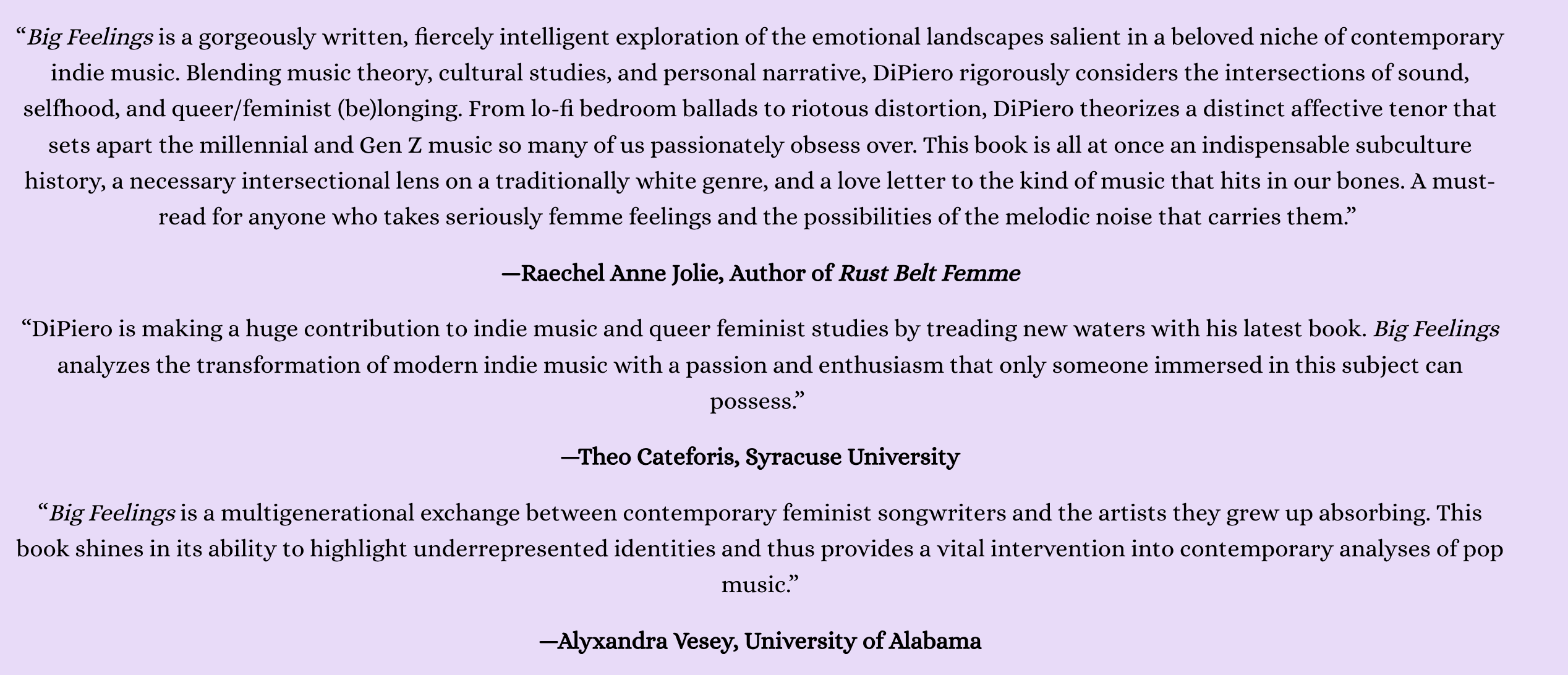
As for me, the University of Michigan Press website has posted three blurbs of which I couldn’t be more proud. Alyx, Theo, and Raechel are literally direct interlocutors who have been influential on Big Feelings from its very inceptions in different but substantial ways. Furthermore, they also represent another important consideration for blurbs: methdological diversity.
Alyx represents an interdisciplinary perspective in academia, bridging (indie) music studies with film, media, and communications from her position as a professor of journalism and creative media. As a more senior scholar with books on new wave, rock history, and another on 90s alternative (forthcoming), Theo’s endorsement represents a view from the heart of popular musicology, one that’s both highly respected and will be recognizable to anyone who’s worked in popular music studies over the past 30 years. Raechel, meanwhile, is both a scholar and a trade author who brings in perspectives from queer theory, anarchist politics, and sex-positive/radical feminism (among other fields!) in ways that I hope will help loop in the groups her readers represent, signaling to those interested in life writing, thoughtful/critical/personal essays, and genres from beyond academia that this book might also have something to offer them.3 Between the three, each speaks to an audience that I hope will see something of their investments reflected in Big Feelings, might give it a shot based on this group of amazing people who have all agreed to say nice things about it in writing.
Cry hard!!!!
How to respond to peer-reviewers in a manuscript situation is a whole different topic, and one that I imagine I’d like to reflect on in the future.
That said, it’s also ok to be sad about it. Sometimes a dream blurb doesn’t work out. More often than not, aspiring writers reaching after established folks will not find success in this endeavor without making personal inroads and building community. This too makes all the sense in the world, while still being difficult for the writer who has been pouring all their energy into the words, only to wake up one day and remember that the words aren’t the only thing that matters to the life of a book. Alas.
And can we talk about how generous and beautiful her blurb is?????
This is so incredibly helpful (and human) to read. Thankyou Dan!